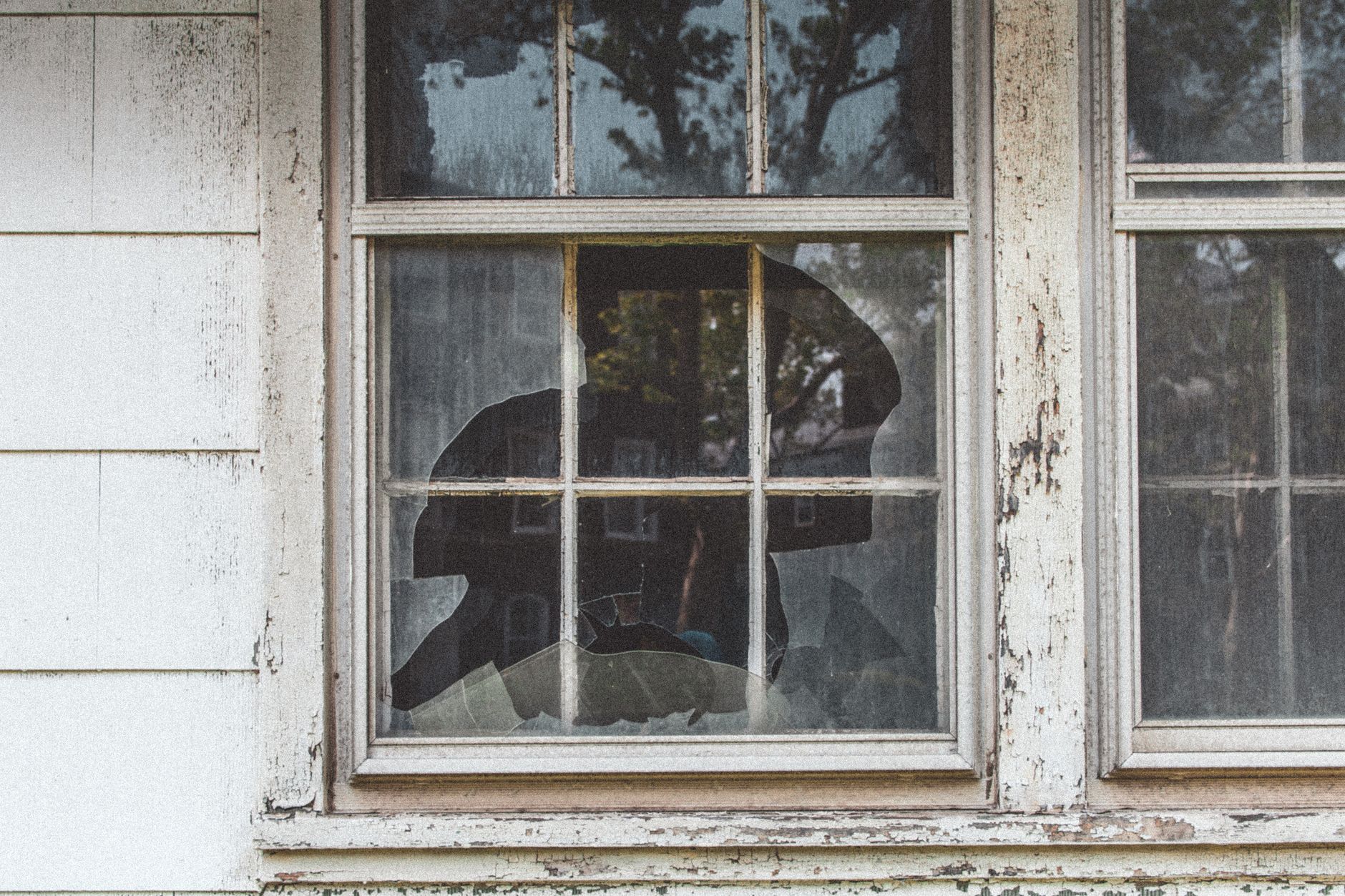
A sprinkler head set six feet from the back wall of a house will put water on the glass above it four or five mornings a week for twenty years. Nobody counts that as a window problem. It gets filed under irrigation, and irrigation gets judged on whether the lawn is green, so the head stays where the landscaper left it and the glass quietly pays for it.
Most of what shortens a window's life on a single story house in the Inland Empire happens on the yard side of the wall, and almost none of it is the window's fault. The frames and the glazing are doing what they were built to do. They are being watered, sandblasted, buried, shaded and reflected at by decisions made with a shovel and a pipe cutter.
The frame tells on the yard before the glass does. A white vinyl window picks up a dull grey band along the bottom rail and up the first few inches of the jambs, always on the elevations the heads can reach, never on the ones they cannot. That band is mineral, not dirt, and the pattern it forms is a map of where the water lands. Read the house that way and you can usually name the zone responsible before you touch a controller.
What overspray actually does to glass
Tap water in this part of California carries a heavy dissolved mineral load, and the share arriving from imported supply is harder still. A droplet lands on warm glass, the water evaporates, and everything that was dissolved in it stays behind as a concentrated film. The next cycle wets that film, dissolves part of it, and dries it again slightly thicker.
For the first season or two it washes off. Past that, the deposit stops being a film sitting on the surface and starts bonding into it. Glass is not chemically inert against alkaline mineral scale sitting on it in heat, and silica scale that has been baked onto south and west facing glass through a few Riverside summers will not come off with vinegar, a razor or a professional polish without taking some of the optical surface with it. The haze people describe as permanent fogging on an outside pane is frequently this, not a failed seal between the panes.
Two tests separate them in about ten seconds. Scale is on the outside and a wet fingertip changes how it looks. A failed sealed unit is between the panes, so nothing you do to either face touches it, and it usually shows as a crescent at the bottom corners that gets worse in the afternoon.
The repair that does not fix it
Polishing etched glass is possible. On a small pane it is sometimes worth it. It is also pointless while the head that caused it is still aimed at the wall, which is the version most people buy, and they buy it twice.
Aiming water away from the building
The fix is boring and costs almost nothing.
Nothing within about five feet of the wall should be on a spray head. Beds against the house want drip, inline emitter tubing or bubblers, all of which put water at the root zone and none of which put it on a frame. That single change removes the majority of the problem on a typical tract layout.
Where a head has to be near the building, make it throw away from it. A half circle or quarter circle nozzle aimed outward along the wall, set back far enough that its arc edge clears the stucco, does the same work as the head currently pointed at the house. Check the arc while it is running, not from the controller.
Pressure matters more than most people expect. A head running well above its design pressure atomizes instead of throwing droplets, and that mist travels on the slightest breeze and lands on everything, including glass twelve feet away. Pressure regulated bodies and matched precipitation nozzles cut drift sharply. So does watering at four or five in the morning rather than at the first hint of a Santa Ana afternoon.
Then walk the yard with the zones running, one at a time, and watch the wall. Five minutes per zone, once, settles questions that otherwise get argued about for years.
Grade, mulch and the openings that got buried
Window frames drain. There are small weep slots along the bottom of the exterior frame, and water that gets past the glazing gasket is supposed to leave through them. They are easy to defeat from outside the house.
A raised planter built against the wall, a decorative gravel band, a new paver patio poured at a convenient height, or just four seasons of mulch topped up each spring, and the finished grade creeps up until it is level with the bottom of the frame. Water now has nowhere to exit and a wet bed sits permanently against the sill. On the older houses in Riverside's Wood Streets, where sills sit low and the framing behind them is real wood, that is how a sill rots from the garden side while the window itself is in good condition.
Keep a visible gap of several inches between the top of any soil, mulch or hardscape and the bottom of a window frame. If a new patio has to come up to the wall, slope it away and give it somewhere to drain that is not the stucco. Poke a straw into a weep slot occasionally. If it is packed with mulch fines or spider debris, clear it.
Planting distance is a window decision
Shrubs get specified at nursery size and planted at nursery spacing. Five years later the branch tips are against the glass.
Three things follow. Airflow stops, so the wall and frame behind the plant stay damp for hours after everything else has dried. Insects get a bridge straight onto the screen and into the track. And in wind, every branch touching the house becomes an abrasive, scuffing the frame finish and wearing holes in insect screen. Santa Ana conditions make that last one fast, because the grit in the air during a wind event is doing the cutting and the branch is just holding it against the surface.
Plant to mature width, not to how it looks the day it goes in. For anything against a wall with windows, leave enough room to walk between the plant and the house, because that is also the access a cleaner, a painter or a glazier will need.
Reflection, shade and cracks that start at the edge
Two heat effects come from the yard rather than the sky.
A new light coloured concrete patio, a pool deck or a field of pale pavers reflects a large amount of sunlight up into the lower part of whatever glass faces it. North facing rooms that were always comfortable can get noticeably warmer after a hardscape project, for no reason anyone connects to the hardscape. Darker paving, a planted strip, or shade over the paving all reduce it.
The second is thermal stress. Glass breaks from differential expansion, not from absolute heat. When part of a pane is in bright sun and part is in deep shade, the hot area tries to grow and the cool area holds it, and the stress concentrates at the edge. Add a small chip or nick in that edge, and a crack starts there and runs. It looks like vandalism or a mystery.
The yard supplies both ingredients. Partial shade lines come from a new patio cover, a pergola with widely spaced slats, a fast growing tree, or a shade sail that covers two thirds of an opening. Edge damage comes from a mower throwing gravel, a string trimmer at ground level, a ladder set against the glass, or furniture stacked against a pane in summer. Full shade over the whole opening is fine. Half a pane in shade all afternoon is the risky pattern.
Before a patio cover goes up over an opening
Attaching a cover to the wall above windows is normal and routinely done badly.
The ledger board has to be flashed so water running down the wall gets over the top of the window head, not behind it. Posts and beams must not block an opening a bedroom relies on for emergency escape. A casement needs its swing arc clear of a post. And the new roof concentrates runoff somewhere, so decide where before it starts landing on one sill.
A short yearly walk
Run every irrigation zone and watch the walls. Look at the outside of the glass with low sun behind you, which shows haze that is invisible at midday. Check the gap between grade and frame on every elevation. Trim anything touching the house. Put a finger in the bottom of the frame and see if it comes out damp. Clear the weeps.
None of that is glamorous and all of it is cheaper than a glass order. The windows on most houses here were never going to fail on their own schedule. They fail on the yard's schedule, and the yard is the part you can change on a Saturday.